Members Message
Disciples, Not Believers - Training in James
In this new series, Faith in Action: A Series on the Book of James, Bruce Billington guides us through James’s powerful letter—written with urgency and moral clarity. This study will challenge us to grow beyond being mere believers, becoming true disciples who live out an authentic and practical Christianity.
🎧 Listen now as we begin this journey through the Book of James—a call to authentic, practical, and enduring faith.
Why the book of James?
2 Timothy 2:15 – “Be diligent to present yourself approved to God as a workman who does not need to be ashamed, accurately handling the word of truth.”.
It is our responsibility to present ourselves as approved workers before God. No one else, including Jesus, can do this for us, and it doesn’t happen automatically. We are expected to undergo proper training to achieve this.
Believers or Disciples?
The great question is: “Am I going to be a believer or a disciple?”.
Our salvation is not dependent on this choice, but our maturity, fruitfulness, and effectiveness in the Kingdom of God certainly are – as are the rewards we will receive for eternity.
1 Corinthians 3:12–15 – “Now if any man builds upon the foundation with gold, silver, precious stones, wood, hay, straw, each man’s work will become evident; for the day will show it, because it is to be revealed with fire; and the fire itself will test the quality of each man’s work. If any man’s work which he has built upon it remains, he shall receive a reward. If any man’s work is burned up, he shall suffer loss; but he himself shall be saved, yet so as through fire.”.This passage is significant. It offers one of the few glimpses into how the eternal reward system works in Christ.
2 Chronicles 16:9 – “For the eyes of the Lord move to and fro throughout the earth that He may strongly support those whose heart is completely His.”.
We cannot succeed in the Christian faith unless we're prepared to work hard. The Bible is a challenging book to read, and our God, while loving and kind, is also demanding and unwavering. Only a disciple understands this.
Any serious athlete or sports person can clearly describe their training routine. How many of us are truly committed to growing in our faith to do the same?
It will include not only our spiritual habits but also our sleep, diet, physical, mental, and emotional health, as well as maintaining the right attitude, etc. If non-Christians are willing to do this to reach a goal, how much more should we be, knowing that eternity is at stake?

Our Current State
Today in the Western world, we live in an era where the Bible has been translated extensively, commented on, preached, and analysed more than ever before. Yet, it is a time when fewer Christians than ever are reading it.
This is tragic for two key reasons:
- It has created immature Christians who don’t understand what God requires of them or how He has empowered them. As a result, they are not aligned with His purposes for humanity or discovering their true selves.
- It means that who Christ is and how He would have us live - which is the way of the Lord - remains a mystery rather than a guiding light on a hill.
Is your life shaped by the Christ of the Bible or by diluted versions of a god meant to suit your every whim? Jesus asked His disciples, “Who do YOU say I am?”. What an important question this has become today.
The book of James' central premise is that the gospel calls sinners to submit to Christ’s authority. People can be mistaken into thinking they believe, when in fact they do not. James teaches that the key factor that sets counterfeit faith apart from genuine faith is the righteous behaviour inevitably shown by those with authentic faith. This alone makes the book of James a vital part of the Christian faith.
The Genius of James
James was not a profound theologian. His genius lies in his deep moral earnestness; his words need to break through our theological debates, our personal assumptions, and the areas where we lack spiritual maturity.
Our journey through this book will help us stay on the path to a biblical, invigorating, transforming Christianity. That is my aim for this series.

Brief Overview
Historical
The book of James was the last to be added to the Canon. It was only by the end of the fourth century that both eastern and western Christendom accepted it as an authentic part of the Scriptures.
The reason for this was that it seemed to contradict Paul’s teaching on justification by faith alone. It was often thought that James expected believers to earn their own salvation. Ultimately, the realisation was that there is nothing inconsistent with seeing Christianity as a way of life that shows clear evidence and fruit in its followers.
It was accepted because genuine faith will always produce genuine fruit. This is the primary message of James’ letter, around which he offers practical advice on living the Christian life.
Key Verse
James 2:18 – “But someone may well say, “You have faith and I have works; show me your faith without the works, and I will show you my faith by my works.”.
The core of James’ letter is quite clear: any form of Christianity that doesn't back up its words with actions isn't genuine Christianity at all. Any claim to the Christian faith that isn't accompanied by deeds isn't genuine belief.
Author
Although there were a few well-known James’s around at Christ’s time, it is generally accepted that James, the Lord’s brother, is the most likely author of this epistle.
Style
James is not a systematic writer. He prefers to jump from topic to topic, sometimes linking them with a loose connection in subject matter, sometimes using a pun to make the transition.
Audience
It seems that James was addressing all believers, not just a single church. It is almost certain that the readers were Jews because the text is filled with the spirit and imagery of Old Testament Judaism, clearly reflecting both the readers’ background and the author’s. It is believed they had been persecuted, causing their scattering throughout the Mediterranean world.
Date
There are good reasons to consider that it was written in the mid-to-late 40s.
Purpose - Maturity
James explores topics that either reinforce or question the integrity and strength of his readers’ faith. He is concerned that, as believers, we should grow towards a mature and steady faith, which involves maintaining a distinctly Christian attitude toward potential stumbling blocks.
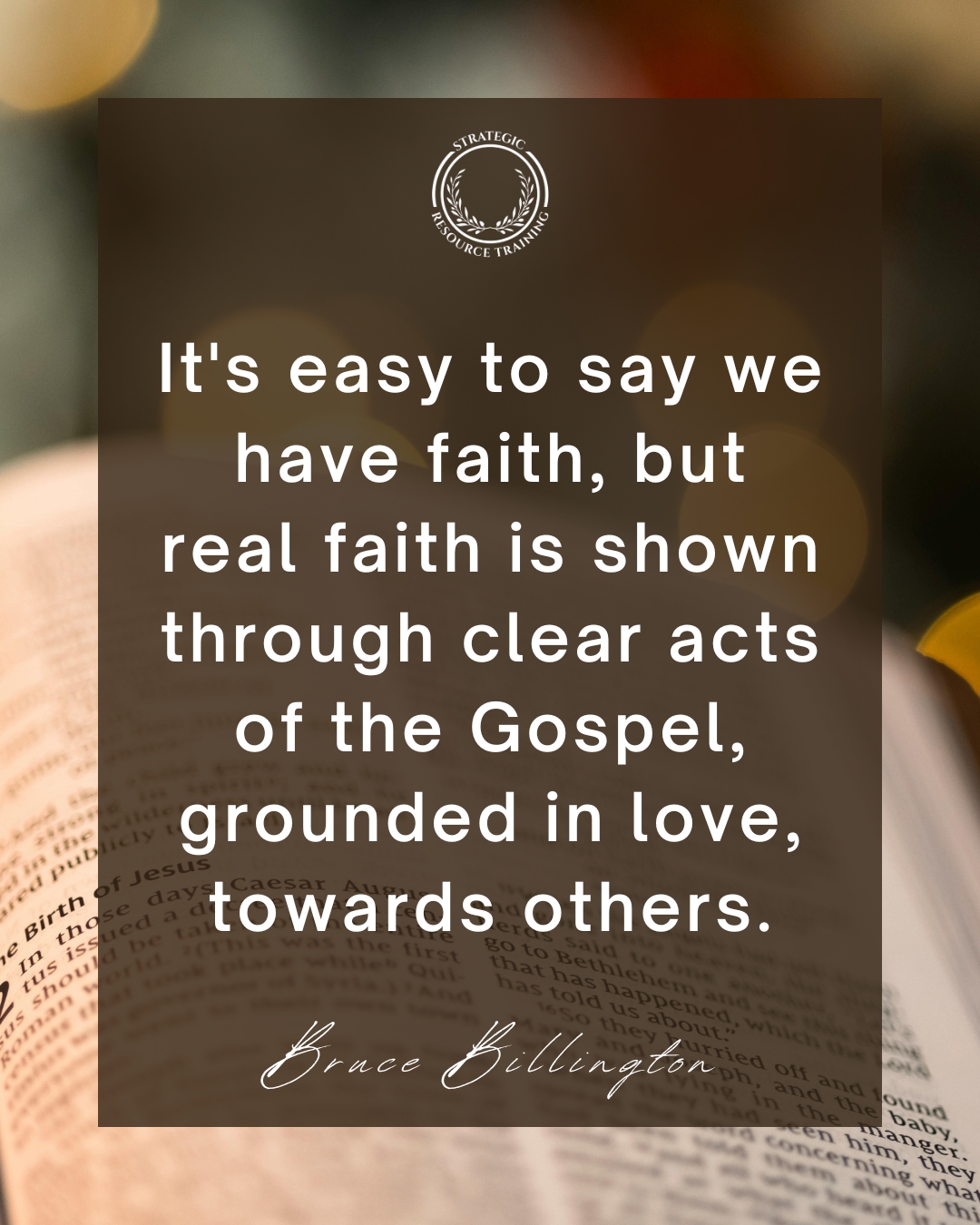
The book demonstrates that genuine faith transforms lives. We are encouraged to put our faith into action. It's easy to say we have faith, but real faith is shown through explicit acts of the Gospel, grounded in love, towards others.
What To Expect?
We will examine trials and temptations, focusing on how they are fundamentally different concepts that require different responses if we want to walk in victory.
We will explore what faith is truly meant to be and how we can apply it to our lives. Grasping this understanding will free us from much of the abuse and condemnation that have infiltrated this area.
Finally, we will explore wisdom and how generously it has been provided as a vital resource for life, and how we can access it.
God bless you.
Bruce Billington