
Members Message July 2026
Members Message
Discipleship Made Easy: Part 2
What True Discpleship Actually Costs
This two-part mini series, Discipleship Made Easy, Bruce Billington explores one of the most overlooked aspects of spiritual growth—the daily discipline required to become like Christ. Moving beyond shallow ideas of discipleship, he reminds us that transformation is not achieved through willpower alone, but through cooperating with the work of the Holy Spirit while faithfully showing up for the process.
In this second episode, What True Discipleship Actually Costs, Bruce explores what it means to actively cooperate with the Holy Spirit in the lifelong process of transformation. He explains that true discipleship is not measured by knowledge alone, but by an increasingly Christ-like character expressed through everyday obedience, a renewed mind, and a biblical worldview. Through practical teaching and biblical examples, Bruce challenges believers to count the cost, embrace the disciplines that shape spiritual maturity, and discover that transformation is the evidence of genuine discipleship.
Key Takeaways
- Patience is tested in mundane moments like driving — Transformation isn't revealed through grand spiritual moments but through everyday activities, making ordinary situations the true measure of spiritual maturity.
- Satan exploits ignorance, not just temptation — Spiritual warfare is won primarily through knowledge of God's Word and biblical worldview, suggesting that education and understanding are as important as willpower in resisting evil.
- True discipleship requires dying to oneself, not just avoiding sin — Following Christ demands active surrender and embracing hardship rather than merely abstaining from wrongdoing, fundamentally redefining what Christian obedience means.
🎧 Listen now to Part 2 to discover why spiritual transformation isn't automatic, but requires a renewed mind, intentional obedience, and a willingness to cooperate with the Holy Spirit as He shapes us into the likeness of Christ.
Introduction
Session One focused on how we are empowered to transform. In this session, we will discuss what we need to do after receiving that power. Transformation is one of the defining features of the Kingdom of God. Last month, we mentioned the psalmist’s heart’s desire in Psalm 17, where he says he will not be satisfied until he wakes in the likeness of the Lord (Verse15). He also offers a key to how this happens – primarily by beholding the face of the Lord. We will explore this further shortly.
What Is Transformation?
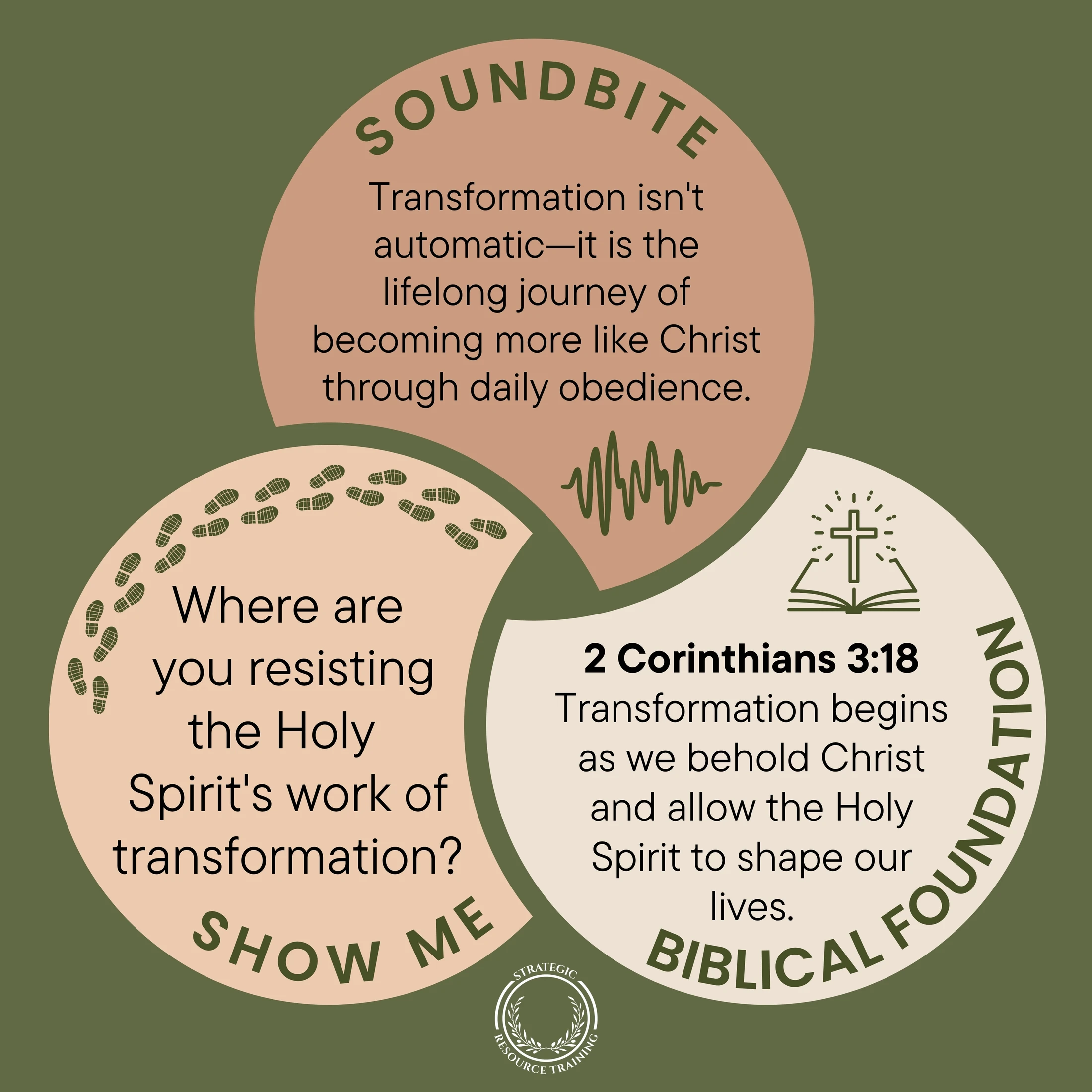
To grasp what transformation means from a true disciple’s perspective, we should see it as becoming more like Christ each day. Both references to this in the New Covenant are powerful, so we should examine them.
2 Corinthians 3:18 – “But we all, with unveiled face, beholding as in a mirror the glory of the Lord, are being transformed into the same image from glory to glory, just as from the Lord, the Spirit.”
What is the purpose of the mirror in this verse? Our Christlikeness is a reflection, which is evident in our countenance, revealing who we are within. The mirror we gaze into reflects what the world observes; how much of the character of Christ do we see in our lives?
In real terms, we measure this by the fruits of the Spirit – love, joy, peace, patience, kindness, goodness, faithfulness, gentleness, and self-control (Galatians 5:22-23).
If we have truly embraced the biblical process of transformation, we should be able to see that these qualities are not only present in our lives but are also growing, and that those around us can testify to this growth.
One of the chief roles the Holy Spirit assumes as the author and finisher of our faith is to produce such a transformation in our lives. We can either cooperate with Him—making the results self-evident—or resist Him and remain immature in our walk with God. The deciding factor rests with us, because the Holy Spirit never fails to do His part when we cooperate.
A major key in this whole process is given in Romans 12.
The Renewing Of Our Minds
Romans 12:2 – “And do not be conformed to this world, but be transformed by the renewing of your mind, so that you may prove what the will of God is, that which is good and acceptable and perfect.”
The transformation Paul refers to here occurs in the depths of our character. What is within us will ultimately manifest in our outward behaviour, especially under pressure.
Often, the Lord allows us to experience pressure to reveal what we need to work on; it is not to condemn us, but so that we realise what needs to change. At that point, we need to cooperate with Him.
We need to grasp the reality of this situation and recognise our significant role in it, because it involves both body and soul (actually, a mind issue). Therefore, the question is: how do we renew our minds (Romans 12:2)?
1. The Word of God
We must keep our minds focused on God throughout the day. How can we do this amidst everything else that invades our minds each day? The good news is that we have the Holy Spirit living within us to help.
2. Develop A Christian Worldview
A worldview is essentially the totality of what any person believes, particularly concerning reality, truth, knowledge, and values. A Biblical worldview comprises a biblically grounded set of beliefs about all aspects of life, including work, recreation, finances, God, life after death, and morality.
This worldview seeks to interpret every facet of life through the teachings of the Scriptures, particularly those of the Lord Jesus Christ. In this mindset, there is no division between the secular and the sacred. We integrate all events and elements of our lives into our understanding of who God is and how He is actively leading us in each situation.
The Goal (or journey)
True transformation will mean that nothing in our lives is merely a random event. Achieving this effectively requires regular reading, exposure to excellent teaching, and a willingness to engage both believers and non-believers in conversations about important worldview issues.
If we approach all these things with humility, the inevitable result will be continuous growth in godly wisdom and the cultivation of a godly way of thinking. There is another important element here.
2 Corinthians 10:5 – “We are destroying speculations and every lofty thing raised up against the knowledge of God, and we are taking every thought captive to the obedience of Christ,”
All those in Christ face an element of warfare. We have spiritual enemies who fight against us for spiritual purposes. Therefore, we cannot allow our fallen nature to flourish or to rise again after we have put it down.
It must be continually crucified and controlled, as it always seeks an opportunity. The weapons of our warfare are mighty (2 Corinthians 10:4-5), meaning they are very powerful; the evidence of truth is convincing because God has shone His light on it for us. This means our lives are accompanied by His blessing, which will cause any opposition set against us to fall before the power of His Word. We embrace a victorious gospel.
Ignorance, prejudice, and unrestrained lusts are Satan’s strongholds. The Bible mentions vain imaginations, carnal reasoning, and high thoughts, or proud conceits, in which people exalt themselves against the knowledge of God (2 Corinthians 10:5).
What this means is that through these methods, the devil strives to keep us from our faith and obedience to the gospel. He seeks to secure his hold on our hearts and to make them his own house or property. But these strongholds are torn down by the gospel, the Word of God, which carries God’s grace and power. Satan has no defence against this.
We do not preach a works-based Gospel of salvation. However, the New Covenant, like the Old, is grounded in obedience. Jesus warned us that unless we are prepared to die to ourselves and embrace the cross, we cannot follow Him as His disciples (Luke 14:27).
We cannot receive His blessings without also accepting His sufferings. We cannot gain His wisdom without reading and studying the Scriptures. We cannot grow without facing trials and tribulations. These elements are interconnected and, together, produce the transformation to which we must return.
The Rich Young Ruler
Luke 18:18-25
This ruler asks Jesus what he must do to inherit eternal life. Jesus tells him he must keep the commandments. The man replies that he has kept them since his youth.
Luke 18:22-24 – “When Jesus heard this, He said to him, “One thing you still lack; sell all that you possess and distribute it to the poor, and you shall have treasure in heaven; and come, follow Me.” 23 But when he had heard these things, he became very sad, for he was extremely rich. 24 And Jesus looked at him and said, “How hard it is for those who are wealthy to enter the kingdom of God!”
1. Jesus Commends Him to the Law
Jesus first evaluated this man by how well he adhered to the law, specifically his obedience to God’s Word. The man claims he was doing well in that regard, and Jesus seems to agree.
2. Jesus Offers Him Something More
Jesus does not give him any more laws to follow or raise the standard any higher. He could have asked, “What about the Sabbath?” or questioned him about some of the other commandments he had overlooked in the first round of questioning.
Instead, Jesus addresses something deep within the young man’s life, seeking to lead him into a new understanding and reality of the Kingdom of God.
3. Transformation of Character
Jesus calls him to transform his character. This man is seeking fulfilment – he knows he is lacking something and desires to be made whole. Jesus addresses his heart by targeting the key issue on which this man’s life is built, namely, the love of money, and requires that he undergo a transformation of character to become a disciple.
The man is not up for it and walks away, quite sad. The price of the Kingdom of God was too high for this God-fearing, seemingly sincere man.
This is the great challenge of the Kingdom of God – it always gets to the heart of who we are and calls for change – even if we are doing quite well – because it is not about moving from bad to good, but rather from one degree of glory to another, which occurs from within. We always have further potential, regardless of how great we may be today.
This foundational stone is the very stumbling block Paul mentions in 1 Corinthians. We cannot be disciples without entering the process of transformation. At the end of the day, that is the measuring stick for individuals, biblical communities, and all true New Covenant endeavours.
Is it by grace? Yes. Does it require work? Yes. Is there one key point that captures it? Yes. Take up your cross daily and follow me. Obedience and sacrifice are fundamental to the New Covenant and essential to any genuine journey of discipleship. If we do not see them in someone’s life, we are left to assume that they are not walking with the Lord.
This is as challenging today as it was 2,000 years ago – we are all invited, but the entrance to it is the narrow door, not the wide one.
May we let nothing keep us from it.
God bless you.
Bruce Billington.