
Members Message April 2026
Members Message
Judging and Depending on God
This episode forms part of our new series, Faith in Action: A Series on the Book of James, where Bruce Billington guides us through James’s powerful letter—written with urgency and moral clarity. Throughout this series, we are invited to move beyond being mere believers and to become true disciples who live out an authentic, practical Christianity.
Misunderstanding biblical judgment has caused real harm to real people, and Bruce wants to set the record straight. In this exploration of James 4:11–15, Bruce draws a careful line between necessary discernment and the kind of harsh, unwarranted condemnation that breaks relationships and wounds the vulnerable. Carefully unpacking common assumptions, he clarifies that Christians are called to judge conduct according to Scripture, as Jesus taught in John 7:24, but not to impose personal convictions where Scripture gives no clear guidance.
He then moves into the issue of planning and self-sufficiency, showing how Western culture often assumes control over the future despite Scripture reminding us that life is temporary and dependent on God’s will. Like vapour or grass that fades quickly, our lives are brief, and our plans must be surrendered to God’s purposes, with even the failure to do good carrying serious spiritual weight and calling believers to constant dependence on God’s direction.
Key Takeaways
- Judging motives is exclusively God's domain – Christians often condemn others' intentions without realizing only God can truly know hearts; misunderstanding this principle has caused real harm to vulnerable people.
- Omission is judged as severely as commission – Failing to do good that God calls you to do carries the same spiritual weight as actively committing evil, challenging the common assumption that avoiding wrongdoing is sufficient.
- Self-sufficiency is a Western spiritual crisis – Our cultural tendency toward independence and overconfidence in controlling our own lives directly contradicts biblical wisdom, which requires surrendering plans to God's purposes in every decision.
🎧 Listen now to Part 6 to discover what faithful Christian living looks like when judgment and self-sufficiency are surrendered to God.
Introduction
Two topics are covered in this lesson: firstly, the issue of judging, and secondly, the issue of depending on God.
1. Judging
James Chapter 4:11-12 – “Do not speak against one another, brethren. He who speaks against a brother or judges his brother, speaks against the law and judges the law; but if you judge the law, you are not a doer of the law but a judge of it. 12 There is only one Lawgiver and Judge, the One who is able to save and to destroy; but who are you who judge your neighbour?”
These seem to be difficult verses. James appears to say we are forbidden to judge. However, this cannot be what he truly means because other passages of Scripture encourage us to make judgments and urge us to exercise discernment, which requires judgment.
Jesus said in John 7:24, where He said, “Do not judge according to appearance, but judge with righteous judgment.”
Jesus was providing us with a way to judge, not banning it. This is also evident in other parts of Scripture. In at least five places in 1 Corinthians alone, Paul tells us we need to judge and how to do it.
So, God has given us the ability to judge, and we can't avoid doing it. It is actually a Christian duty to judge conduct and character.
So, let’s dig into what James is really meaning here.

1. Don’t Speak Against One Another
In the first part of the verse, we are warned not to speak against one another. The Greek word katalaleite means speaking anything that could hurt or harm someone, even if it is true, unless it is necessary, such as on the witness stand or to prevent someone from harming others.
Leviticus 19:16 - You shall not go about as a slanderer among your people, and you are not to act against the life of your neighbour; I am the Lord. In everyday life, we should aim to encourage and exhort each other. We are also advised to believe the best of one another until proven wrong.
If we cannot speak well of someone, it is better to say nothing. Otherwise, we only add to the hatred and persecution in the world. We are meant to be peacemakers and builders, not warmongers.
2. Judging the Law?
What does James mean by speaking against the law? What he is saying is that anyone who quarrels with his brother and condemns him of anything that is not a violation of the Word of God is actually saying, “I know better than the Law - I am a judge of it.”
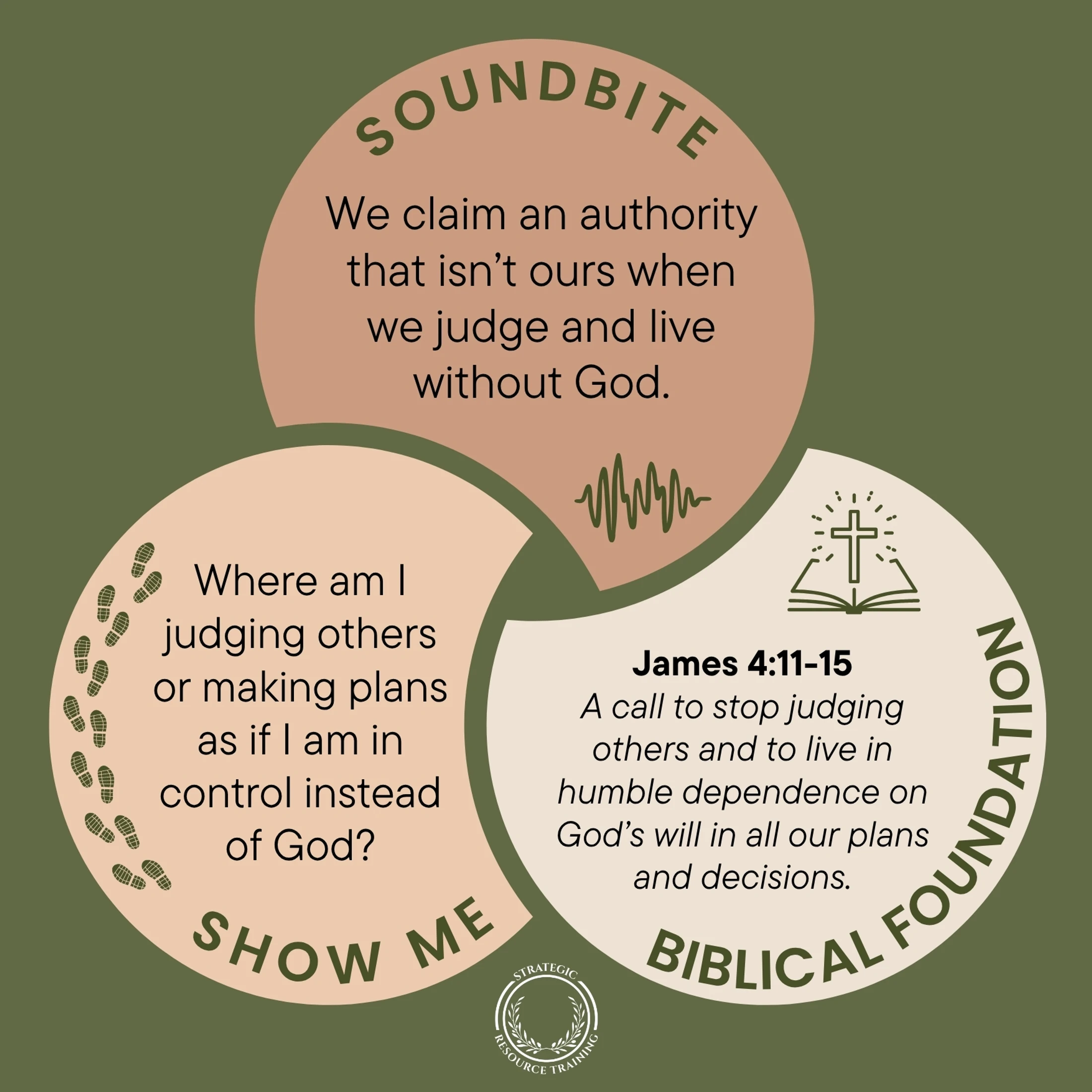
We must not judge any form of behaviour that is not mentioned in Scripture. If we judge others' actions based on anything other than Scriptural teaching, we claim an authority that isn’t ours, and God won’t allow us to remain in this position because He alone has that role.
James 4:12 makes it clear that God is the Lawgiver, and He alone holds the power to decide how we should behave.
How to Judge
We are not to judge hastily, harshly, or unkindly. This means we should not listen to rumours or gossip, and we shouldn’t be swayed by other people’s initial impressions or their narrow-mindedness. It also means we should steer clear of mistaken views of others' suffering, such as blaming it on sin or a lack of faith. This is something those who believe in the gifts have done very poorly, causing real hurt to others.
In forming our judgments of conduct and character, we should consider principles such as these:
- We have no right to draw an unfavourable conclusion unless and until we have full knowledge of all the facts.
- We should be cautious about judging too harshly and making calls beyond our authority.
- When actions can be seen as either positive or negative, we are obligated in love to see the positive side unless proven otherwise (1 Corinthians 13).
Judging Motives
In 1 Corinthians 4:5, Paul rebukes the Corinthians for judging his motives. Such judgment strikes at a person’s thoughts and intentions - and only God truly knows these. Paul was accusing the Corinthians of judging in a way reserved only for God.
The Scriptures state that the motives behind each person’s actions are hidden deep within their mind and heart, and that God, at the end of the age, will “expose the motives of men’s hearts.” He will reveal what is concealed in darkness – and He claims that He alone possesses all the information needed to do this.
Relational issues often break down because we judge the thoughts and intentions of a person's heart – and we often get it completely wrong. It is not good to do this because we don’t have enough information to make that call. Of course, the Holy Spirit can reveal these things to us – but ensure it is Him you are hearing from – not your own prejudices.
It should comfort us to know that the person who will be our final judge is Jesus Christ alone. It is He who will either “justify,” or condemn us according to the true motive of our heart.
__largepreview__.webp)
2. Depending on God
James 4:13-16 – “13 Come now, you who say, “Today or tomorrow we will go to such and such a city, and spend a year there and engage in business and make a profit.” 14 Yet you do not know what your life will be like tomorrow. You are just a vapour that appears for a little while and then vanishes away. 15 Instead, you ought to say, “If the Lord wills, we will live and also do this or that.” 16 But as it is, you boast in your arrogance; all such boasting is evil.”
In biblical times, the Jewish people were a nation of market traders. They would go to markets to buy and sell their goods. They also took them to the commercial centres of other countries.
A trader might be found one year at Antioch, the next at Alexandria, the following year at Damascus, and the fourth perhaps at Corinth.
Now, what James is urging is that we don’t make any plans without first considering what God’s will is.
God may well have something different in mind that He wants us to be doing, so we should seek Him first and constantly in all our planning.
What James is really condemning is the spirit of self-sufficiency regarding any planning of life. (Psalm 49:11; Isaiah 56:12; Luke 12:19).
It is both unwise and pointless to exclude God from our planning - we are not the Lord of our own lives, and we very likely have little control over what the future holds. We are merely a vapour that appears today and vanishes tomorrow.
Psalms 103:14-16 – “14 For He Himself knows our frame; He is mindful that we are but dust. 15As for man, his days are like grass; As a flower of the field, so he flourishes. 16 When the wind has passed over it, it is no more, And its place acknowledges it no longer.”
We must remember that our times are not in our own hands, but at the disposal of God; we live as long as God appoints, and within the circumstances God appoints, and therefore must be submissive to Him, even as to life itself.
All our actions and plans are under God's control. Our minds may be filled with all our worries and concerns. We may intend to do things for ourselves, our families, or our friends, but something unexpected often arises and disrupts our plans.
__largepreview__.webp)
Our plans for action and activity should stem from time spent with God; everything we create and undertake should depend entirely on Him. When we do this, we can be assured that God's wisdom, power, and blessing are bestowed upon us, empowering us to work all things together for our good.
The point is this – He has planned our lives for us and wants to guide us towards what is best – but to do this, we need to hear from Him – and once we do, walk in obedience.
James 4:17 – “Therefore, to one who knows the right thing to do and does not do it, to him it is sin.”
Here, James reminds us that once we seek God, we must follow His instructions. Don’t just ask Him to bless your activities; ask Him what those activities should be. Then, plan accordingly—always seeking not only what to do but also how to go about it.
Additionally, if we fail to do the good we ought to do, we are judged the same as if we had done evil. Christian living isn’t just about avoiding bad actions - it also calls us to actively do good, guided by the Holy Spirit.
As a result, we need to ensure that our behaviour reflects what God would have us do while also avoiding what Scripture forbids.
God bless.
Bruce Billington